
Malaysia · Project ID GCSP1039
Soil and Flame
Malaysian biochar projects. Where farm waste gets a second life and carbon goes back to the ground where it belongs.
Project overview
Pit-to-Plot.
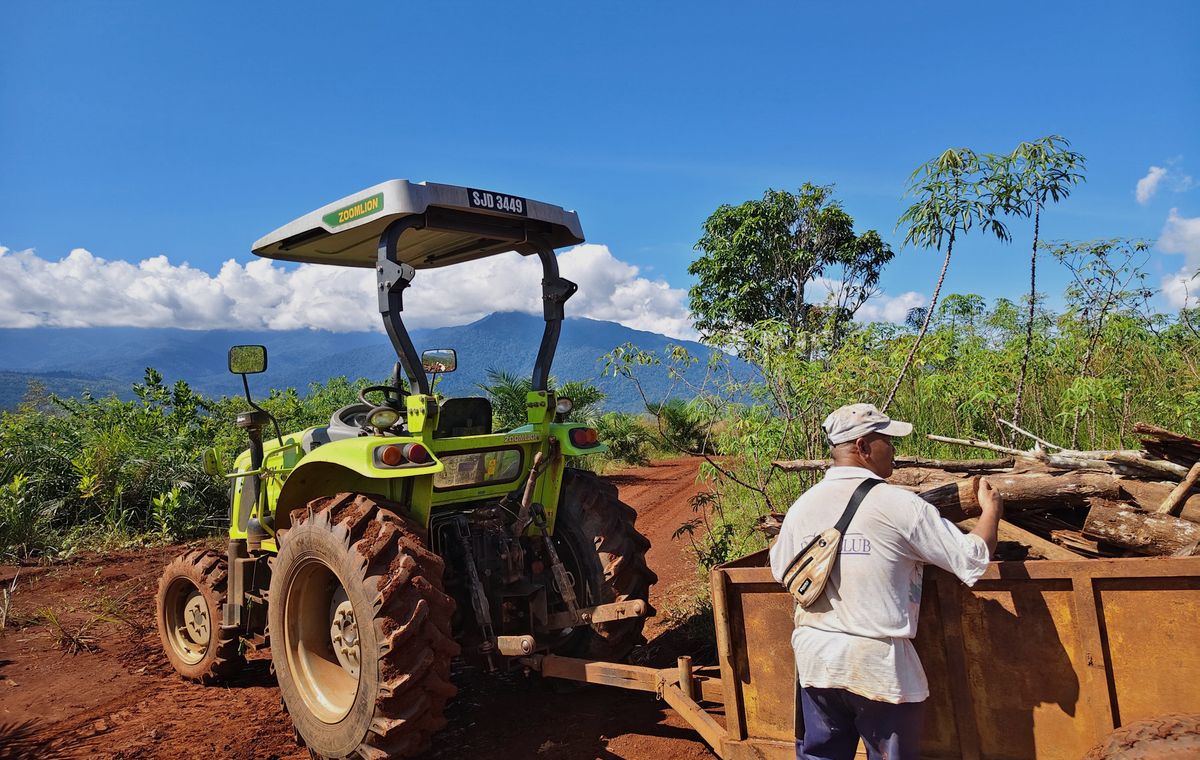
Tucked inside Malaysia’s Greater Klang Valley hills, this project flips the script on waste by turning woody residue from the world’s largest organic plantation into biochar. Our signature “Pit-to-Plot” approach keeps things refreshingly simple: no fancy machines, no complex reactors, just pyrolysis right in the soil.
Each pit becomes a small carbon factory, turning what used to be burned into long-lived storage while improving soil fertility and water retention. Together they capture up to 1,200 tonnes of CO₂ a year, proving that small local actions punch above their weight.
Every site doubles as a living lab, where farmers, researchers and nature are all part of the experiment. Audited by CERES-CERT AG and registered under Carbon Standards International, this is Malaysia’s first artisanal biochar project to issue verified carbon credits.
The science
Simple yet impactful.
Local farm waste becomes carbon-storing biochar where it is produced — directly in the soil, using low-tech pyrolysis pits. Affordable, replicable, community-driven.
No fossil fuels
Low-input, high-output method relying solely on controlled pyrolysis of on-site biomass.
Net CDR-to-feedstock
For every 5 tonnes of woody waste, 1 tonne of stable carbon is sequestered — low operating cost, high scalability for distributed rural systems.
Real field conditions
Our site and partner smallholder farms act as testbeds where biochar is produced, applied and monitored in the field, not the lab.
Hybrid verification
On-ground sampling combined with data monitoring, for transparency and accountability through to issuance.
Latest soil results
+15–25% increase in soil organic carbon. +20% improvement in moisture retention within one cropping cycle. Up to 50% reduced fertiliser dependency, with improved crop resilience.
Carbon capture data
Each soil pit yields biochar locking away an estimated 2–3 tonnes of CO₂e per hectare, depending on feedstock composition and burn conditions.
Scalability
Simplicity drives scale.
Up to 50,000 tCO₂e a year
Expanded across available woody waste streams in the Klang Valley, this model could offset up to 50,000 tonnes CO₂e annually, cutting emissions from waste burning and landfill accumulation.
Scalable, adaptable, accessible
Fits farms of any size. Works with plantation waste, garden trimmings and crop residues. Requires minimal training and equipment investment.
- Greater Klang Valley Biochar ProjectOperational
- Borneo Biochar ProjectOperational
- Northern Borneo Biochar ProjectOperational
Registered, rated and endorsed by